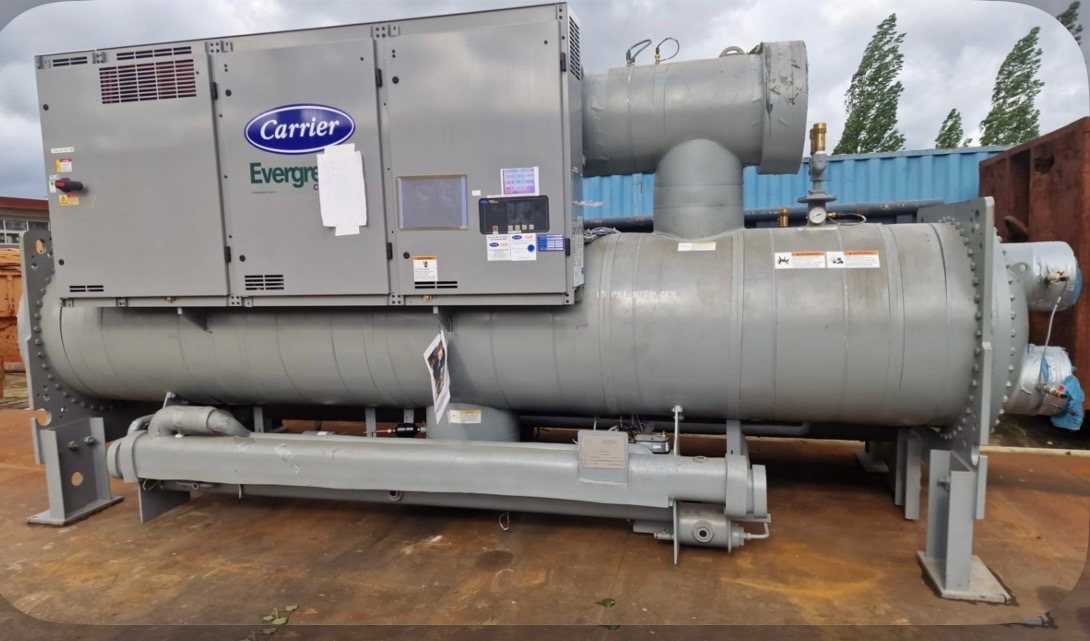
Screw Chiller Buyers in Morgan City, Louisiana
From surplus unit to removal
Have a used screw chiller in Morgan City, Louisiana to remove? We are chiller buyers, and a test run is not required to request an upfront cash offer. The buyer handles crane service, rigging, disconnects, refrigerant recovery, loading, hauling and freight. Share the machine's visible details and the site's known restrictions so the work can be coordinated with authorized personnel.
The details worth sending
When a plate is difficult to read, send the clearest safe photo available along with any relevant equipment schedule. Identify the particular machine in a room containing multiple units and note which numbers are incomplete. A buyer can use those starting points to ask focused follow-up questions without relying on a guess about model or age.
Identify the connections and machine
Photograph the unit nameplate and visible compressor housings; note how many compressors are present if clearly visible. Do not assume the number of compressors from the word screw. If the housings or labels are not visible without opening a cover, say the count is unknown and provide a safe overall photo instead.
Map the components
Describe the actual configuration rather than relying on one broad label. Air-cooled and water-cooled describe how heat is rejected; centrifugal, screw and scroll refer to compressor types, and a chiller can have one description from each group. If you do not know the arrangement, exterior photos and available documents are enough to start. Avoid removing panels or assuming a compressor type from the brand.
Measure the load, not just the rating
A truck and crane are selected around the real load, not the chiller's rated cooling tons. Send available length, width, height and documented weight for the machine and for any separate included enclosure. Also share the nameplate capacity so the buyer can identify the equipment. It is fine to say that dimensions or a weight still need confirmation.
Details that affect the review
Share available maintenance history, including oil or compressor service records, without opening the system. An older service invoice can establish what work was reported, but it does not guarantee present condition. Flag incomplete maintenance history, known damage and missing parts honestly; no operating demonstration is needed to start a review.
Plan from the real address
The regional context for Morgan City includes the lower Atchafalaya River and the U.S. 90 corridor. It extends into St. Mary Parish and St. Martin Parish; confirm the parish for the property. For a waterfront or industrial property, identify the actual parish, road entrance and any known bridge, access or exposure concerns. Give the street address and the unit's position on the property; a regional highway does not establish which gate, route or loading area can be used at that site. For this screw chiller, identify accessible compressor and connection photos with the correct equipment location.
Power and separate controls
Record power details from labels or drawings already available, and say if the voltage or phase cannot be confirmed. A separate drive or starter may have its own enclosure and removal path, and it may not be part of the purchase. The buyer handles disconnects using qualified personnel, working with authorized staff who control the site's isolation procedures.
Keep the circuit closed
Tell the buyer whether a refrigerant designation comes from a nameplate, a later conversion label or a service record. If the source is missing or the charge is unknown, say that plainly. The buyer handles recovery with qualified personnel. There is no reason for the seller to fit gauges, open a valve, mix refrigerants or release any contents.
Plan the interfaces and access
Identify visible fluid and electrical connections and note the equipment's location and removal clearances. Include any separate power or control cabinet if it belongs in the transaction, and identify lines that the site believes are shared. Qualified personnel plan the disconnects while the buyer's riggers evaluate the path and lift.
Agree on the work boundaries
Explain who can grant entry to the property and who understands the machine's interfaces with the rest of the facility. Their input can clarify restricted work areas, ongoing cooling loads and any permitted removal window. The buyer handles the removal services and coordinates with authorized staff. Missing schedules or drawings can be discussed without committing the site to an unapproved outage.
Access starts at the unit
The first obstacle may be inside the building rather than on the road. Tell the buyer where the unit sits, how it is reached and where a truck might be allowed to load. Identify narrow openings, overhead obstructions and any restricted travel paths from existing measurements. The buyer's professional team verifies the route and determines the handling plan for the specific equipment.
The actual lifting constraints
Give the buyer any available shipping weights, lifting drawings and pictures of the machine's surroundings. Explain known limits on crane setup, floor loading, overhead clearance or staging space, and note where information is unavailable. The buyer coordinates the crane and qualified riggers. An equipment plate or a general diagram is useful context, but it is not a substitute for a site-specific lift plan.
Where can the truck load?
After the machine leaves its installed position, it still needs a safe staging place and a truck-accessible loading area. Share the location of gates, internal roads and any known overhead or vehicle restrictions. The buyer coordinates loading, hauling and freight. The freight team will evaluate the actual load dimensions and route rather than assuming that a nearby highway solves access inside the property.
Send the information on hand
There is no need to make the machine operational before contacting a buyer. Available photographs, plate details and the location can support an upfront cash offer. Tell the buyer which parts are included and what is still uncertain, including access or refrigerant information. The removal team can work through those details with the facility before the work is arranged.