Carrier Chiller Buyers in Sulphur, Louisiana
Offer and removal scope
If you have a used Carrier chiller in Sulphur, Louisiana, we buy chillers rather than sell them. Share what you know for an upfront cash offer; no equipment testing is required. The buyer handles crane service, rigging, disconnects, refrigerant recovery, loading, hauling and freight, coordinating qualified personnel with the site. A precise inventory and an honest account of access restrictions help shape the removal plan.
Openings, turns and overhead limits
A facility address can contain more than one gate, building and equipment room. Specify the right entrance and unit location, along with any escort or vehicle restrictions known to the site. If a roof or indoor route is involved, provide opening dimensions and photographs from safe locations. The removal team will assess turns, floor transitions and overhead clearance as well as the doorway.
Start with the unit's labels
Photograph the Carrier chiller nameplate and record its model, serial number and stated capacity if legible. If the plate is worn, send a wide photo that shows where it is located and transcribe only what remains legible. An equipment schedule may supply a missing model or capacity, but label the source so it is not mistaken for a reading from the plate.
Capacity is not shipping weight
Cooling tons describe capacity; they do not tell the freight team how much the machine weighs. Share the rated tons from the plate and the documented operating or shipping weight separately, if available. Give overall length, width and height, including projections, and say whether a separate cabinet has its own dimensions. Mark an estimate clearly instead of presenting it as a measured or documented figure.
The actual lifting constraints
If the machine must pass through a building opening or over a parapet, show the riggers the relevant route and any measurements already on file. Provide the unit-specific lifting documents and known weights where available. The buyer arranges crane and rigging services; the professional team decides on lifting points and whether an approved component separation is needed.
Photograph the equipment in context
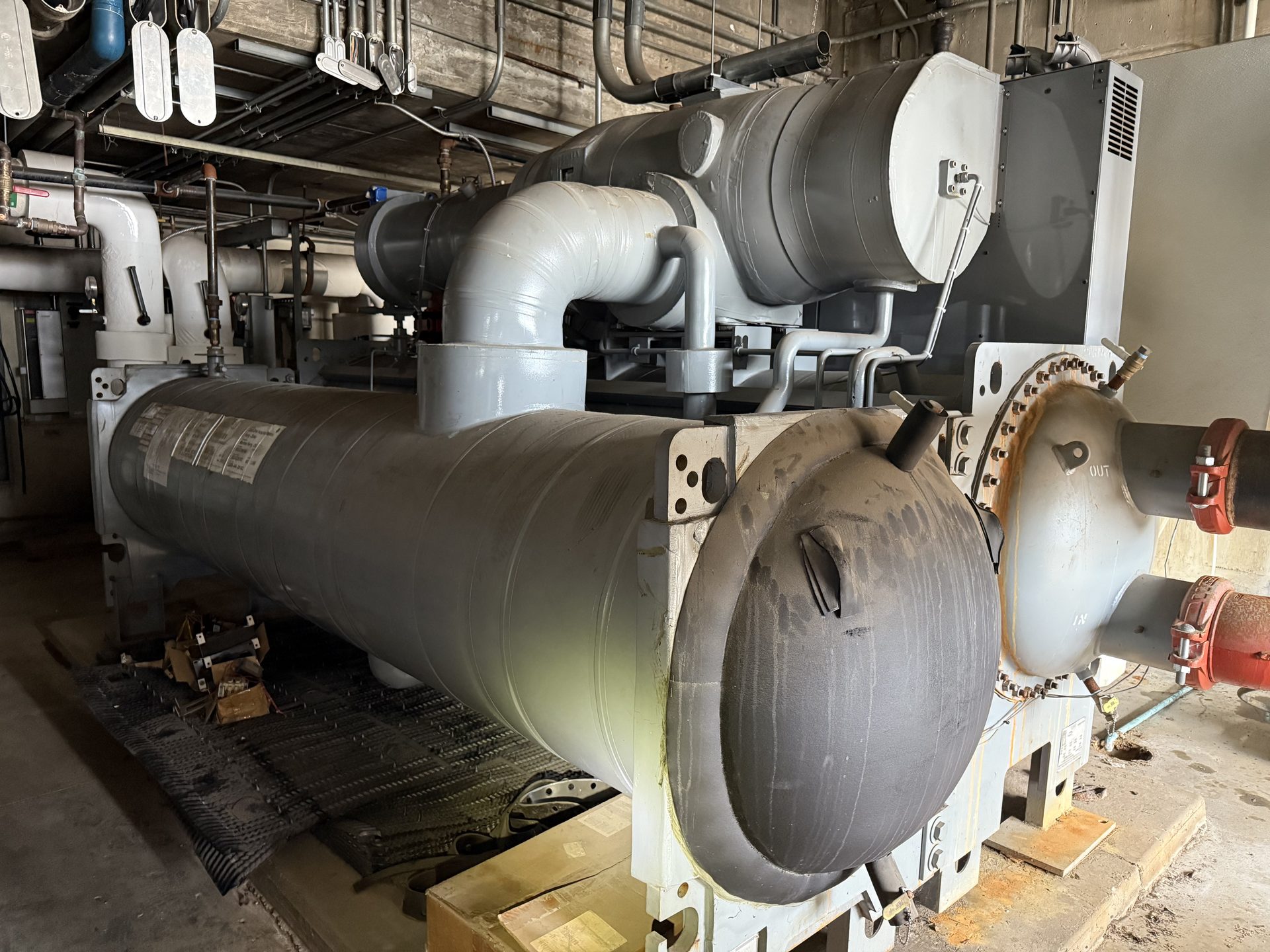
Share exterior photos of the compressor, heat exchangers and control cabinet so the configuration can be identified without running the unit. A view of the whole assembly alongside closer views helps distinguish equipment included with the chiller from neighboring plant equipment. Say whether a starter or controls are separate, if you know, and which pieces are included in the proposed sale.
Where the equipment sits
The regional context for Sulphur includes west Calcasieu and the I-10 corridor toward Texas. It is in Calcasieu Parish. At an industrial property, confirm gate access and the site's approved downtime rather than assuming the equipment can be removed immediately. Give the street address and the unit's position on the property; a regional highway does not establish which gate, route or loading area can be used at that site. If a separate starter or control is included, show where it sits relative to the chiller and the path to the loading area.
From staging to hauling
After the machine leaves its installed position, it still needs a safe staging place and a truck-accessible loading area. Share the location of gates, internal roads and any known overhead or vehicle restrictions. The buyer coordinates loading, hauling and freight. The freight team will evaluate the actual load dimensions and route rather than assuming that a nearby highway solves access inside the property.
Make the equipment list clear
The scope of a purchase should be clear before removal is planned. Name the machine or machines being offered and identify included modules, controls and separate cabinets if known. Note any equipment that is shared or will stay at the property. Photographs labeled by building or unit help avoid mixing records from two similar chillers, especially when a plant schedule contains combined capacities.
Plan around the installed machine
Provide any model-specific lifting or installation documents and note the route from the chiller to the loading area. The buyer can share the documents with the lifting team. A passage that looks wide enough at the doorway can still be restricted by a pipe, bend or change in floor level; mention those conditions instead of assuming the chiller will fit through intact.
A useful condition history
It is fine to say that operating condition is unknown. Send the records the site already has, note visible exterior damage and identify components that are absent or excluded. Avoid drawing conclusions about internal condition from appearance alone. There is no need to energize the chiller, connect test equipment or remove covers in order to request an offer.
Electrical information for the team
Record power details from labels or drawings already available, and say if the voltage or phase cannot be confirmed. A separate drive or starter may have its own enclosure and removal path, and it may not be part of the purchase. The buyer handles disconnects using qualified personnel, working with authorized staff who control the site's isolation procedures.
Keep the circuit closed
A retired chiller can still contain refrigerant, so its status should not be inferred from its operating history. Provide the safely visible designation and any known service or recovery notes, including gaps. The buyer coordinates the recovery work through appropriately qualified personnel; the seller leaves the circuit closed and does not vent or transfer refrigerant.
Access and operating constraints
Before removal, define what stays in service and who can authorize work at the property. Existing site rules may cover escorts, work windows, protected areas or shared utilities. The buyer arranges the removal team and coordinates with authorized personnel; the site supplies its requirements. Any window discussed is a planning input, not a promise that a particular date will be available.