Daikin Chiller Buyers in Sulphur, Louisiana
A practical way to start
If you have a used Daikin chiller in Sulphur, Louisiana, we buy chillers rather than sell them. Share what you know for an upfront cash offer; no equipment testing is required. The buyer handles crane service, rigging, disconnects, refrigerant recovery, loading, hauling and freight, coordinating qualified personnel with the site. A precise inventory and an honest account of access restrictions help shape the removal plan.
From the chiller to the loading area
A facility address can contain more than one gate, building and equipment room. Specify the right entrance and unit location, along with any escort or vehicle restrictions known to the site. If a roof or indoor route is involved, provide opening dimensions and photographs from safe locations. The removal team will assess turns, floor transitions and overhead clearance as well as the doorway.
Match the plate to the equipment
Record the Daikin model and serial numbers and photograph the capacity and refrigerant information on the unit nameplate. Use the actual unit plate rather than assuming that every machine in the same plant has the same refrigerant or rating. If a label was changed or a record is missing, send the photographs and explain the uncertainty.
Measure the load, not just the rating
If the equipment schedule has a tonnage, match it to the correct machine and indicate whether the number is for one unit or a combined plant. Also provide available dimensions and any documented shipping or operating weight. A cabinet that fits inside the building may still have attachments that limit its exit; capacity alone says nothing reliable about those clearances.
Plan the lift around the site
A clear ground-level view does not guarantee a clear lift: overhead services, structural limits and the available crane position also matter. Send the buyer what the site knows about those constraints, along with documented dimensions and weight. Professional riggers arranged by the buyer develop the equipment-specific plan. Do not tie on lifting gear or attempt to shift the chiller yourself.
Photograph the equipment in context
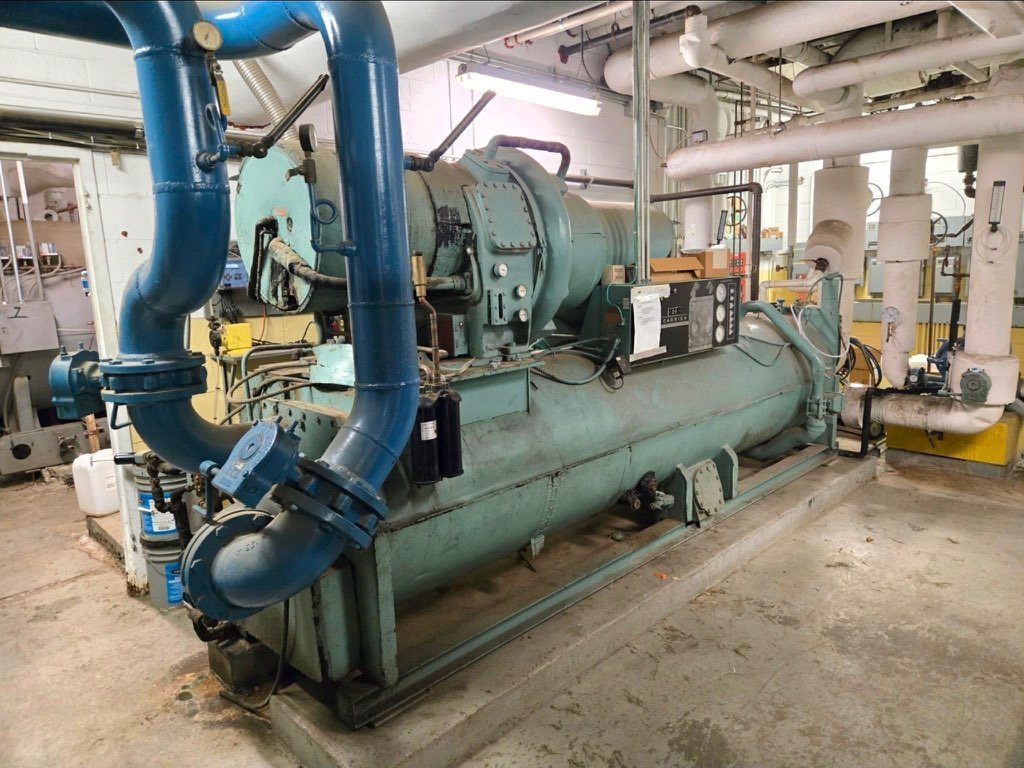
Share photos showing the full unit, visible compressors or modules, and fluid connections without removing any covers. A module count and visible connection photos are especially useful if the equipment is arranged in a bank. Indicate whether the capacity you have is for one piece or the entire group, and do not remove guards to get a closer view.
Plan from the real address
The regional context for Sulphur includes west Calcasieu and the I-10 corridor toward Texas. It is in Calcasieu Parish. At an industrial property, confirm gate access and the site's approved downtime rather than assuming the equipment can be removed immediately. Share the actual address, building and approved entrance where known. The buyer's team must assess the specific property rather than infer a clear route from a regional map. If a separate starter or control is included, show where it sits relative to the chiller and the path to the loading area.
Loading and the road out
If a unit or separate cabinet has to be staged before loading, tell the buyer what space the facility can make available and any restrictions on its use. Share measurements, documented weights and the route through the gate. The buyer arranges loading, hauling and freight; its personnel assess whether the proposed route and vehicle access are workable for the actual load.
Define the purchase scope
Define the boundaries of the proposed purchase before arranging a lift. Photograph the machine in place, list any included starter or controls, and mark equipment that will remain. For a bank, distinguish individual modules from the total system. When ownership or inclusion of a component is uncertain, tell the buyer and resolve it with the authorized site representative.
Plan around the installed machine
Mention rooftop location, screened enclosures or other access limits that could affect crane or freight planning. A roof screen or narrow service yard can alter the path from the unit to a truck. Give the buyer the building address, approximate location of the machine and any known limits on crane setup; the lifting team will assess the actual site.
Power and separate controls
Provide the voltage, phase and frequency listed on an accessible nameplate or equipment schedule, if legible. Note any separate starter, drive or control enclosure and whether it is included or shared. Do not open a panel or handle wiring to collect these details. The buyer coordinates qualified disconnect personnel with authorized site staff, who identify isolation boundaries and any equipment that must remain energized.
Keep the circuit closed
Share the refrigerant designation and charge quantity from the plate or records if available, along with any retrofit label. The original plate does not necessarily describe a later conversion, and an unknown charge should stay unknown until qualified personnel assess it. The buyer handles refrigerant recovery with appropriately qualified personnel. Keep the circuit closed: do not attach gauges, transfer or vent refrigerant.
Keep remaining services in view
Explain who can grant entry to the property and who understands the machine's interfaces with the rest of the facility. Their input can clarify restricted work areas, ongoing cooling loads and any permitted removal window. The buyer handles the removal services and coordinates with authorized staff. Missing schedules or drawings can be discussed without committing the site to an unapproved outage.