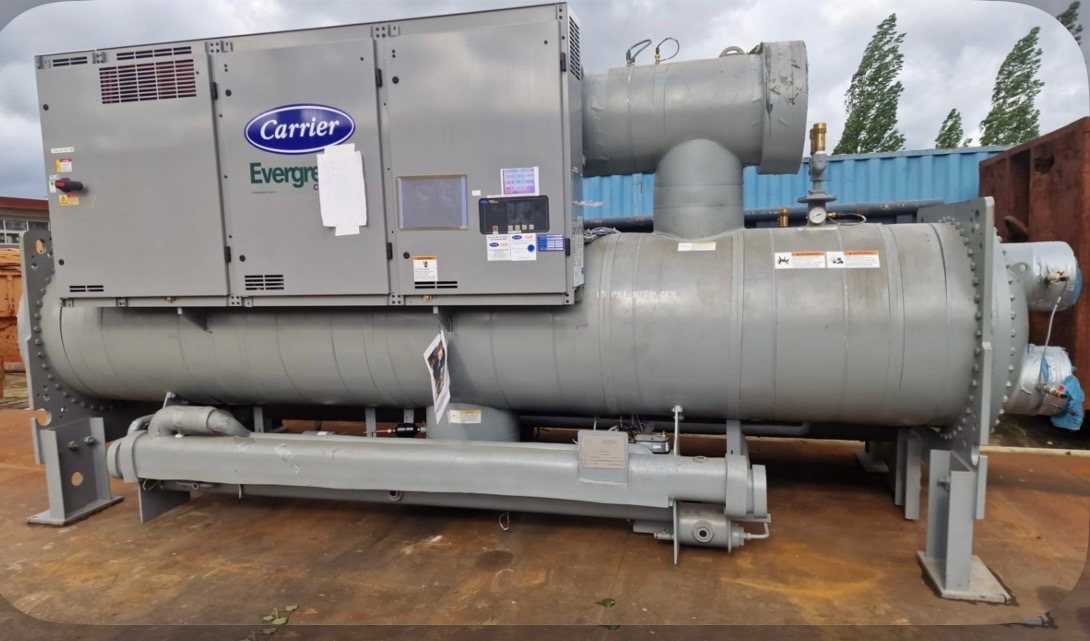
Centrifugal Chiller Buyers in Shreveport, Louisiana
Offer and removal scope
If you have a used centrifugal chiller in Shreveport, Louisiana, we buy chillers rather than sell them. Share what you know for an upfront cash offer; no equipment testing is required. The buyer handles crane service, rigging, disconnects, refrigerant recovery, loading, hauling and freight, coordinating qualified personnel with the site. A precise inventory and an honest account of access restrictions help shape the removal plan.
Access starts at the unit
A rooftop, basement, mechanical room and fenced yard each create different access questions. Provide the actual building and unit location, any known opening dimensions and a safe photo of the route. Mention screens, parapets, overhead services or a tight corner if present. Site restrictions should be confirmed with authorized staff rather than inferred from a map or from the machine's size.
Identify the connections and machine
Share nameplate photos and any available records identifying the compressor, refrigerant and rated cooling capacity. Capacity and refrigerant are properties of the specific machine, not something to infer from the compressor category. An old equipment schedule or a partial plate is useful when clearly marked as incomplete or unverified.
Plan from the real address
The regional context for Shreveport includes the Shreveport–Bossier area and the I-20 and I-49 corridors. It extends into Caddo Parish and Bossier Parish; confirm the parish for the property. Because the city spans more than one parish, confirm the street address and actual parish, particularly near a boundary. Give the street address and the unit's position on the property; a regional highway does not establish which gate, route or loading area can be used at that site. For this centrifugal machine, describe the path for the shell and any separate starter or drive that is included.
Capacity is not shipping weight
If the equipment schedule has a tonnage, match it to the correct machine and indicate whether the number is for one unit or a combined plant. Also provide available dimensions and any documented shipping or operating weight. A cabinet that fits inside the building may still have attachments that limit its exit; capacity alone says nothing reliable about those clearances.
Plan the lift around the site
If a unit is above grade or inside a constrained room, describe the possible route and any known structural or overhead limits. A safe photo of the surrounding area can help, along with unit-specific rigging documents. The buyer's rigging team assesses lift points, crane position and whether components can move as assembled. The seller is not expected to perform rigging or dismantling.
Details that affect the review
Identify separate starter, drive or control cabinets if present and say whether they are included. A starter or drive can be physically separate and may not be obvious in a picture of the chiller. Mark which cabinets belong to the machine, what is included and whether any controls also serve equipment that will remain.
Loading and the road out
A good freight discussion includes the equipment's documented weight, outside dimensions, gate location and space available to load. Identify narrow internal roads, overhead obstructions or restrictions on large vehicles if known. The buyer handles loading and hauling as part of the freight arrangement, while its team checks the actual route with the site. Cooling tons alone cannot establish transport requirements.
Identify the machine
A short identification packet can save a later round of questions: photograph the unit as installed, its accessible nameplate and any separate cabinet included in the transaction. List the model, serial number and rated cooling capacity if legible. Missing documentation is not a barrier to starting a conversation, and the seller does not need to take panels off.
Removal considerations for this design
Document shell dimensions and available equipment-room openings; any disassembly should be planned by qualified personnel for that unit. Measure only where safely accessible and share original drawings when available. Door size alone may not describe the full route: bends, overhead services and floor load limits can determine whether the proposed path needs further assessment.
Define the purchase scope
One photo can show several assets without showing which one is surplus. Mark the intended chiller on a wide image, then pair its plate with the same asset in the equipment list. Say whether associated controls or modules are part of the sale. If the owner has not decided what is included, flag that question for the buyer and site representative to resolve.
Report condition without a test
It is fine to say that operating condition is unknown. Send the records the site already has, note visible exterior damage and identify components that are absent or excluded. Avoid drawing conclusions about internal condition from appearance alone. There is no need to energize the chiller, connect test equipment or remove covers in order to request an offer.
Identify shared power equipment
Record power details from labels or drawings already available, and say if the voltage or phase cannot be confirmed. A separate drive or starter may have its own enclosure and removal path, and it may not be part of the purchase. The buyer handles disconnects using qualified personnel, working with authorized staff who control the site's isolation procedures.
Refrigerant records and recovery
A retired chiller can still contain refrigerant, so its status should not be inferred from its operating history. Provide the safely visible designation and any known service or recovery notes, including gaps. The buyer coordinates the recovery work through appropriately qualified personnel; the seller leaves the circuit closed and does not vent or transfer refrigerant.
Access and operating constraints
An approved work window and a site contact are more useful than a proposed date that no one has confirmed. Identify access, escort and shutdown restrictions, and explain which cooling or process services must continue. The buyer coordinates the removal work with authorized personnel. Where the schedule or operating boundaries remain undecided, flag those questions for the facility rather than guessing.